uptop

Self-hosted uptime monitoring with a TUI over SSH.

No browser. No client install. Just ssh -p 23234 your-server.

MIT License Go 1.26 Docker Pulls

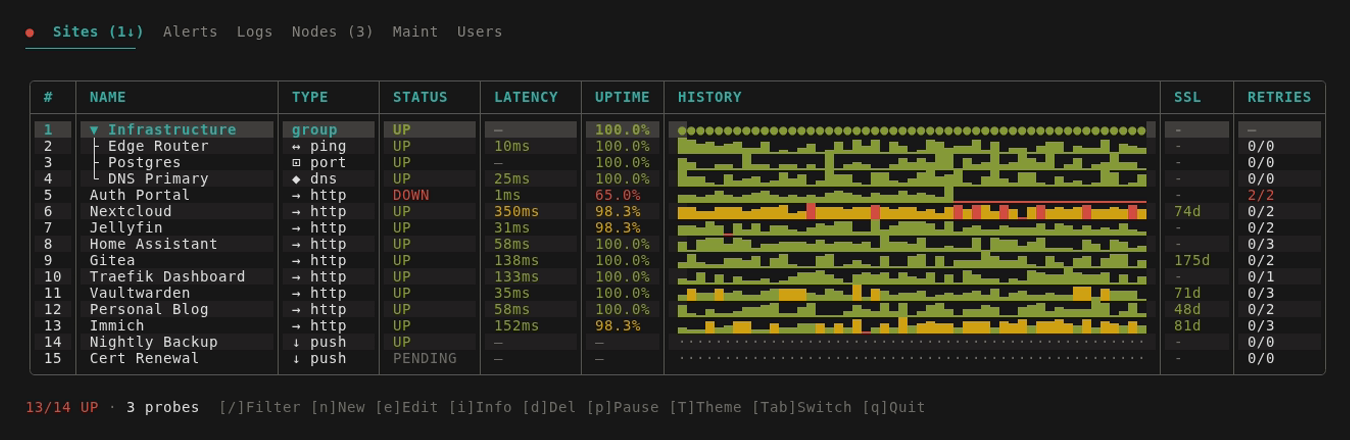
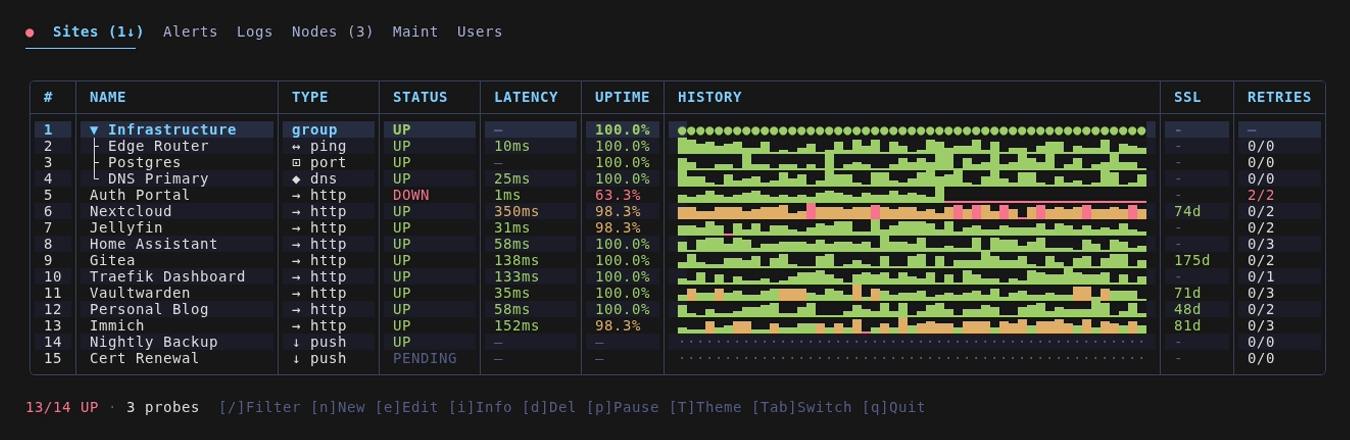
uptop monitors view
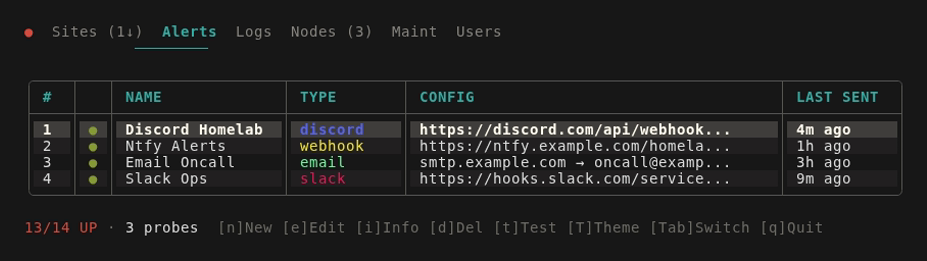
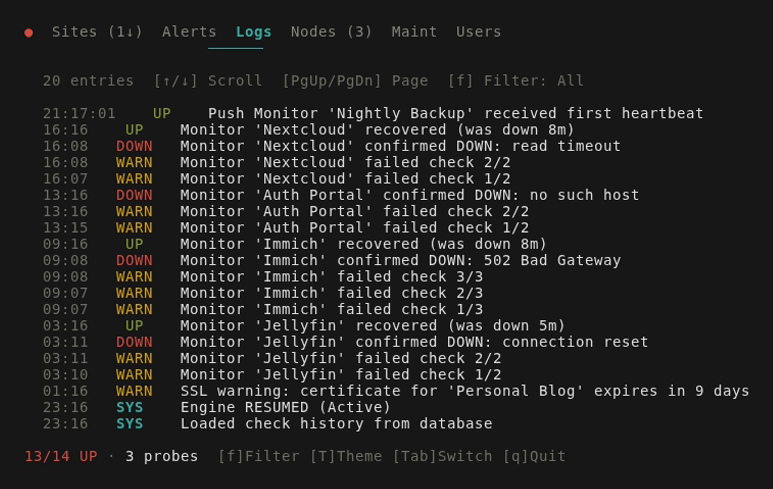
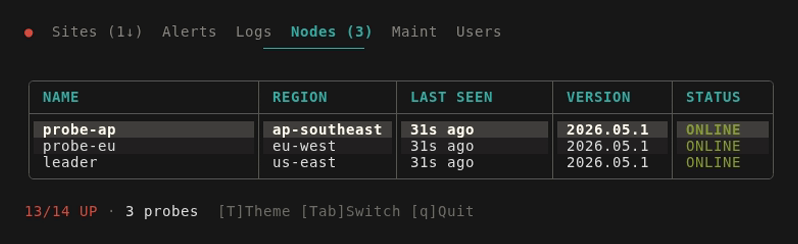
## What is this An uptime monitor you manage entirely from the terminal. It runs as a server, exposes an SSH endpoint, and drops you into a full TUI — monitors, alerts, logs, nodes, all there. Built on [RDGames/go-upkeep](https://github.com/RDGames/go-upkeep). Rewritten for clustering, config-as-code, and a proper dashboard. ## Features - **6 check types** — HTTP, Push (heartbeat), Ping, Port, DNS, Groups - **9 alert providers** — Discord, Slack, Email, Ntfy, Webhook, Telegram, PagerDuty, Pushover, Gotify - **Config as code** — define monitors in YAML, apply declaratively, version control your setup - **HA clustering** — leader/follower with automatic failover - **Prometheus metrics** — `/metrics` endpoint, wire it straight to Grafana - **Public status page** — HTML + JSON, toggle with an env var - **SQLite or Postgres** — SQLite for single-node, Postgres for production - **Uptime Kuma import** — migrate from Kuma with one command ## Screenshots
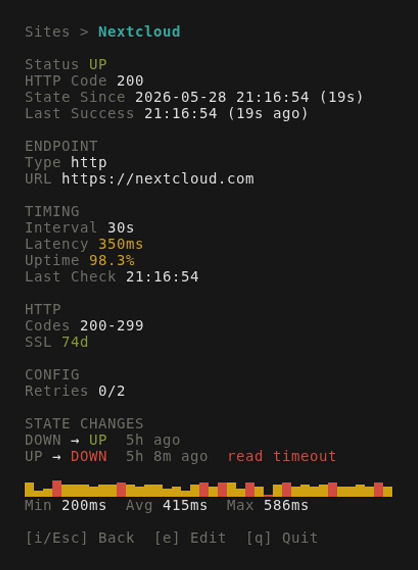
detail panel alerts view
logs view cluster nodes
theme selection
## Quick start ```bash go run cmd/uptop/main.go ssh -p 23234 localhost ``` Want some data to look at first: ```bash go run cmd/uptop/main.go -demo ``` ## Install
Docker (recommended) ```yaml services: uptop: image: lerkolabs/uptop:latest restart: unless-stopped ports: - "23234:23234" - "8080:8080" environment: - UPTOP_DB_TYPE=sqlite - UPTOP_DB_DSN=/data/uptop.db - UPTOP_STATUS_ENABLED=true # - UPTOP_ADMIN_KEY=ssh-ed25519 AAAA... you@host volumes: - ./data:/data ``` First run: set `UPTOP_ADMIN_KEY` to your SSH public key, or attach to the container and add it in the Users tab.
Binary Download from [Releases](https://gitea.lerkolabs.com/lerkolabs/uptop/releases).
From source ```bash go install gitea.lerkolabs.com/lerkolabs/uptop/cmd/uptop@latest ```
## Config as code Export your current monitors: ```bash uptop export -o monitors.yaml ``` Apply a config file: ```bash uptop apply -f monitors.yaml uptop apply -f monitors.yaml --dry-run # see what would change uptop apply -f monitors.yaml --prune # delete anything not in the YAML ``` Full reference in [docs/config-as-code.md](docs/config-as-code.md). ## Environment variables | Variable | Default | Description | |---|---|---| | `UPTOP_PORT` | `23234` | SSH server port | | `UPTOP_HTTP_PORT` | `8080` | HTTP server port (status page, push, metrics) | | `UPTOP_DB_TYPE` | `sqlite` | `sqlite` or `postgres` | | `UPTOP_DB_DSN` | `uptop.db` | Database path or connection string | | `UPTOP_STATUS_ENABLED` | `false` | Enable public status page | | `UPTOP_STATUS_TITLE` | `System Status` | Status page title | | `UPTOP_CLUSTER_MODE` | `leader` | `leader` or `follower` | | `UPTOP_PEER_URL` | | Leader URL for follower nodes | | `UPTOP_CLUSTER_SECRET` | | Shared key for cluster + API auth | | `UPTOP_INSECURE_SKIP_VERIFY` | `false` | Skip TLS verification for checks | | `UPTOP_ADMIN_KEY` | | SSH public key seeded as first admin on startup | ## Migrating from Uptime Kuma Export your Kuma backup JSON, then: ```bash curl -X POST http://localhost:8080/api/import/kuma \ -H "X-Upkeep-Secret: your-secret" \ -H "Content-Type: application/json" \ -d @kuma-backup.json ``` ## License MIT — see [LICENSE](LICENSE).